
A Buddhist Charter #100
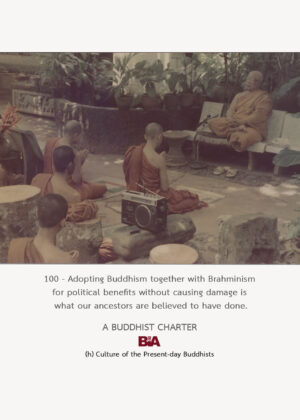
100 – Adopting Buddhism together with Brahminism for political benefits without causing damage is what our ancestors are believed to have done.
(In Chaiya, Surat Thani, Thailand, almost all old temples dating back to the Srivijaya period have a Brahman uposatha on the eastern side of their locations. The images of Avalokiteshvara are found in many of them. At Wat Kaew, digging yielded at Shivalinkam and an image of Ganesh at the main worshiping location in the big Buddhist pagoda, which is the main object of the temple. This was to promote, as a primer, morality among children and uneducated women, for example, who could not attain the profound principles of Buddhism. Brahminism was used in these ways because it was adopted before Buddhism.)
– – ❖ – –
From “A BUDDHIST CHARTER,” translated from the Thai (กฎบัตรพุทธบริษัท) by Mongkol Dejnakarintra.
– – ❖ – –
[FOREWORD] This book, A Buddhist Charter, which consists of 136 proposed items, results from the 50th anniversary commemoration of Suan Mokkh on Visakhapuja Day of 1982. The Venerable Than Achan Buddhadasa of Suan Mokkh drafted and presented motions to the Buddhist assembly there so that they would consider them and reach a common agreement which would become a practical guideline for Buddhists in general. The assembly consisted of two committees, one scripture or theory oriented and the other proper social practice oriented. The two committees joined forces in considering and refining the motions until they reached mutual satisfaction. They then declared the motions as a Buddhist charter.
…
The charter is divided into 10 groups, namely, (a) general; (b) practical principles that should be considered and put to rest; (c) different views that should be eliminated; (d) interpretation of the terms; (e) problems between religions; (f) international problems of the present world; (g) things that deserve to be understood and written down as rules; (h) culture of the present day Buddhists; (i) the ultimate dhammas that everybody should know; (j) miscellaneous problems. It can be seen that this charter covers almost all aspects; and it should be used a guide in tackling problems properly and in accordance with the Buddha-dhamma principle…