
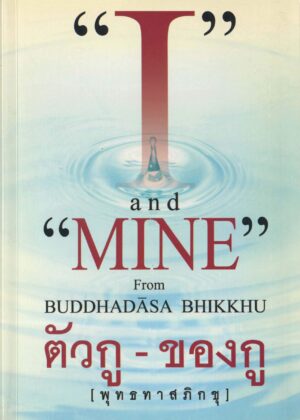
I and Mine
The Thai Buddhists in general have always been very traditional in their beliefs and practices. Much emphasis is being given to rites and rituals and the performances of religious ceremonies. People go to temples or monasteries to observe the moral precepts and they like to ‘make merits’ by offering some basic requisites or other material things to the monks who bless them with verses in Pali. No one seems to really care about Nibbana. Nobody bothers to strive for supreme calmness, of the mind. People are more concerned with their daily needs. They are interested only in themselves or their personal needs.
The late Buddhadasa Bhikkhu realised that something had gone very wrong with Thai Buddhism. It was too full of superstitious beliefs and practices. People were too ignorant to reach the core of true Buddhism. Being an expert in Hinayana Buddhism, Buddhadasa nevertheless made the efforts to learn Chinese Zen Buddhism. He combined Zen Buddhist teaching with Theravada school of thoughts and created a much more sensible Buddhism for the Thai Buddhists.
We are living in a world of increasing selfishness. People all over the world have become more and more self-centred, and people do bad things, very often some unspeakably bad things. The sense of having a ‘self’ in them is the powerful force that drives them to seek their own personal interest in disregard for moral ethics. In this book called “Tua Ku Khong Ku” which can be literally translated as ‘I’ and ‘mine’, Buddhadasa pointed out the need to abandon this sense of being ‘I’ and ‘mine’. It is the original source of selfishness. He also talked about ‘suññata’ – ‘voidness’ or ’emptiness’. The realization of ‘suññata’ is the highest level of Buddhist practice because in ‘suññata’, no ‘I’ and no ‘mine’ exist. It is Nibbāna.
(Translator’s Foreword)
| START READING |