
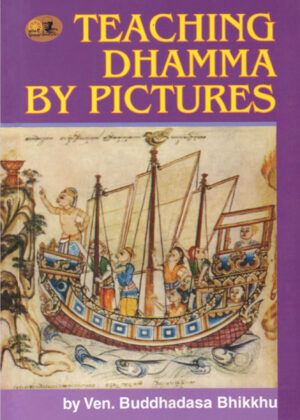
Teaching Dhamma by Pictures
The use of pictures as a method for explaining the Dhamma (Buddhist Teachings) has been popular in Siam since the Sukhothai or early Ayuthia period. The manner of representation has undergone, of course, various changes through the years so that the pictures illustrate period art as well as Dhamma. Though there is still disagreement in fixing the date of some illustrations, the examples presented here are of the Bangkok period (about 100 years old). Three illustrated manuscripts of this period on Dhamma have been found in the town of Chaiya (Surathani Province) and the volume presented here is the largest of them. Upon examination, it was found that all three manuscripts have the same theme for their illustrations.
The illustrated manuscript reproduced here was, in the original, a traditional Thai manuscript called Samut Khoi which is a long roll of paper folded concertina-wise into leaves and then written on both sides. In this form, the illustration was presented first, followed by a few lines of explanation on a particular aspect of Dhamma such as Meditation and so forth. Cambodian script was used in those days for all religious works though the language is Siamese.
The pigments used were produced locally, most of them derived from native trees. The sequence of the illustrations has been rearranged here, for a more lucid presentation.
TEACHING DHAMMA BY PICTURES
Explanation of a Siamese Traditional Buddhist Manuscript by Ven. Buddhadasa Bhikkhu
| START READING |
German: Siamesische Illustrationen Der Buddhalehre
Bahasa Indonesia: Mengajarkan Dharma Melalui Gambar